
For decades, brain-computer interfaces, or BCIs, seemed to belong more to science fiction than to everyday medicine. The idea of connecting the human brain directly to a computer sounded futuristic: a patient could imagine moving a hand, and a machine could interpret that intention. Today, however, that concept is moving steadily closer to clinical reality in the United States.
In 2026, American researchers and medical institutions are increasingly testing BCIs not simply as laboratory demonstrations, but as potential tools for restoring communication, movement, and other lost neurological functions. Recent clinical developments involving patients with amyotrophic lateral sclerosis (ALS), paralysis, stroke, and other severe motor impairments suggest that the technology is entering an important transition period.
The goal is not to create a futuristic “superhuman.” For many researchers and patients, the goal is much more practical: helping someone communicate with family, operate a computer, control a robotic device, or potentially regain some degree of independence.
A New Chapter for American Neurotechnology
The United States has become one of the most active centers for implantable BCI research. Universities, medical centers, startups, and technology companies are competing to solve one of medicine’s most difficult problems: how to translate electrical activity in the brain into useful commands outside the body.
The technology works by detecting neural signals associated with a person’s intention. Sophisticated algorithms can then interpret those signals and convert them into actions, such as moving a cursor, selecting letters, or generating speech.
The concept is particularly important for people whose brains can still generate movement or speech intentions but whose muscles can no longer carry those intentions out.
That distinction is crucial.
A patient with severe paralysis may understand a conversation perfectly but be unable to speak or move. A BCI potentially creates a new communication pathway that bypasses damaged nerves and muscles.
Recent work at UC Davis illustrates how significant this shift could become. Researchers reported that a man living with ALS was able to use a BCI system at home to communicate, work, and interact with the digital world without continuous researcher assistance. The system decoded neural activity related to attempted speech and movement and translated it into text and computer control.
That kind of independence could represent a major step beyond the traditional laboratory model.
From Demonstration to Real-World Medical Tool
One of the biggest challenges facing BCIs has never been simply proving that brain signals can control a computer. Researchers have already demonstrated that possibility.
The harder question is whether a system can remain reliable outside a research laboratory.
A hospital environment is controlled. A patient’s home is not.
At home, patients may experience changing temperatures, movement, wireless interference, equipment limitations, fatigue, and countless other variables. Medical technology must also remain dependable over long periods while being comfortable and practical enough for everyday use.
This is why recent progress in independent, at-home BCI use is attracting so much attention. It suggests that researchers are beginning to address the gap between a spectacular demonstration and a technology that could genuinely improve a patient’s daily life.
The next generation of BCIs will therefore need more than impressive neural decoding. They will need reliability, safety, ease of use, software stability, wireless connectivity, and dependable power management.
This is where seemingly small engineering details become extremely important. A sophisticated implant cannot provide continuous assistance if its supporting electronics cannot operate reliably. Depending on the system architecture, a carefully engineered medical battery can become an essential part of maintaining stable operation in a medical environment.
Speech Restoration May Become One of the Most Important Applications
Imagine being unable to speak but still knowing exactly what you want to say.
For people with advanced ALS or other severe neurological conditions, this can become a devastating reality. Traditional assistive communication technologies can help, but they may require residual muscle control, eye movement, or other physical abilities.
BCIs offer a different approach.
Instead of asking a patient to physically type a message, the system attempts to decode the neural activity associated with speech or movement intentions.
This area is developing rapidly in the United States. In 2026, University of Michigan researchers reported the first-in-human implantation of Paradromics’ Connexus wireless BCI as part of a clinical trial involving a woman with motor neuron disease and severe difficulty speaking. The implant uses a high-density intracortical array designed to capture neural signals and ultimately support communication.
The significance goes beyond one device.
It demonstrates how American BCI research is moving toward a model in which restoring communication is treated as a serious clinical objective rather than merely an experimental technology demonstration.
If future systems can reliably translate intended speech into natural-sounding language, the effect could be profound. Patients might communicate faster, participate more actively in conversations, work with digital devices, and regain forms of independence that neurological disease had taken away.
Stroke Rehabilitation Could Be the Next Major Frontier
Speech restoration is only one part of the story.
Stroke is another area where researchers are exploring whether brain-computer interfaces can help patients regain lost motor abilities. A stroke can damage the brain regions responsible for controlling movement, leaving patients with weakness or paralysis even when other neurological functions remain intact.
Traditional rehabilitation can be effective, but recovery varies considerably between individuals and can require months or years of intensive therapy.
BCI-based rehabilitation takes a different approach. Instead of focusing only on the physical movement a patient can currently produce, researchers can attempt to detect the patient’s intention to move.
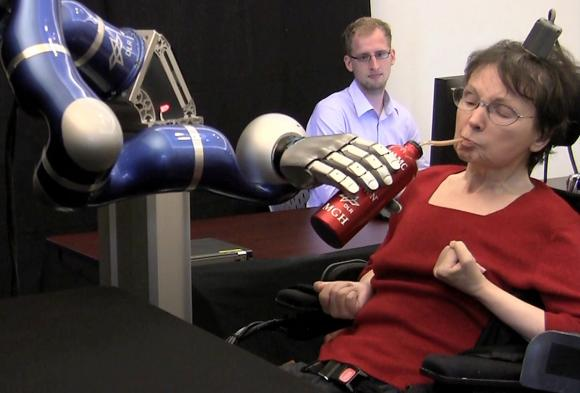
The system can then connect that intention to an external action, feedback signal, robotic device, or stimulation system.
In 2026, CorTec’s Brain Interchange system received U.S. FDA Breakthrough Device designation for an investigational application aimed at restoring motor function in stroke patients. The system is designed as a fully implantable, wireless platform capable of recording neural activity and delivering adaptive stimulation.
This points toward an especially interesting future: BCIs may eventually become bidirectional.
Instead of simply reading the brain, a system could potentially read neural activity, interpret it, and then send carefully controlled signals back into the nervous system.
That could create a feedback loop between brain, computer, and body.
The Technology Behind the Implant Matters
When people hear “brain-computer interface,” they often focus on the electrode array or the artificial intelligence decoding the signals.
But a medical BCI is much more than a neural sensor.
It is a complete medical system involving electrodes, signal processing, wireless communication, software, stimulation hardware, data security, and power management.
For an implanted device, power reliability is particularly important. A system intended to operate continuously must carefully balance performance, energy consumption, heat generation, physical size, and long-term reliability.
This makes the medical battery more than a supporting component. It can influence how small an implant can become, how frequently it needs maintenance, how much data it can process, and how practical the system is for long-term use.
As BCI designs become increasingly sophisticated, engineers will need to make every component work together efficiently.
The challenge is similar to building a miniature computer that must operate inside the human body while meeting medical safety requirements.
Brain-Computer Interfaces Are Expanding Beyond Paralysis
Another reason 2026 is attracting attention is that BCI research is beginning to move beyond the traditional focus on paralysis.
In April 2026, a brain-computer interface based on research from Rice University received FDA approval for its first clinical trial in patients with treatment-resistant depression. The device, developed by Motif Neurotech, is designed to investigate a new approach to treating patients whose depression has not responded adequately to conventional therapies.
This represents an important change in how researchers think about BCIs.
Instead of using a brain interface only to restore a lost physical function, scientists are investigating whether neural technology could directly interact with brain circuits involved in psychiatric conditions.
The approach remains experimental, and FDA authorization to conduct a clinical trial does not mean that the treatment has been proven safe and effective for general medical use.
Still, the direction is significant.
If researchers can identify specific neural patterns associated with neurological or psychiatric disorders and respond to those patterns in real time, future therapies could become more personalized than conventional treatments.
AI Could Make BCIs More Powerful
Artificial intelligence is another major factor accelerating BCI development.
The brain produces enormous amounts of complex electrical information. Turning that information into useful commands requires sophisticated algorithms capable of identifying patterns that may change over time.
AI can help systems adapt to individual patients rather than relying entirely on fixed models.
This could become especially important for speech BCIs. Human speech is extremely complex, and the neural patterns associated with intended speech can vary between individuals and even within the same person.
A more adaptive system could learn from the patient and gradually improve its interpretation.
In the long term, this could create a personalized neural interface that becomes better at understanding the user’s intentions through continued use.
However, AI also introduces new concerns.
The more powerful these systems become, the more sensitive the data they process may be. Recent research has highlighted privacy concerns surrounding implantable BCI data because neural signals can potentially reveal information far beyond conventional health records.
That means America’s BCI future will not be determined by engineering alone.
It will also depend on ethics, cybersecurity, medical regulation, and patient consent.
Safety and Regulation Remain Major Obstacles
The path from clinical trial to routine hospital treatment is long.
The FDA has established guidance for implanted BCI devices intended for people with paralysis or amputation, including considerations for nonclinical testing and clinical studies.
But regulators still face difficult questions.
How should doctors measure whether a BCI truly improves a patient’s life? How long should an implant remain functional before it is considered reliable? What happens if the device stops working? How should neural data be protected? Who controls that data?
These questions become even more complicated when a BCI is designed not only to record brain activity but also to stimulate the nervous system.
Researchers and regulators therefore need to evaluate the entire ecosystem surrounding the device.
A successful BCI will have to demonstrate not just technical performance but also meaningful clinical benefits.
What Will the Hospital of the Future Look Like?
It is easy to imagine a future hospital where neurological patients receive an implant and immediately gain extraordinary new abilities.
Reality will probably be more gradual.
BCIs are likely to enter medicine through highly specific applications first. Patients with severe paralysis, ALS, stroke-related disabilities, or other conditions may become early candidates for carefully controlled clinical programs.
Over time, successful technologies could become more compact, reliable, wireless, and easier to manage.
Eventually, the most important innovation may not be a dramatic “mind-reading” breakthrough. It could be a collection of smaller improvements that make BCIs practical enough for everyday medical care.
Better electrodes.
More efficient algorithms.
Smaller electronics.
Longer-lasting medical battery technology.
More secure wireless communication.
Better surgical techniques.
And, perhaps most importantly, systems designed around the actual needs of patients rather than the capabilities of the technology itself.
The Human Impact May Matter More Than the Technology
The excitement surrounding companies and futuristic demonstrations can sometimes overshadow the people who may benefit from this technology.
For a healthy person, controlling a computer with thoughts might sound like an impressive technological trick.
For someone who has lost the ability to speak, it could mean saying “I love you” to a family member again.
For a stroke survivor, controlling a robotic arm could represent a step toward independence.
For a person living with severe paralysis, operating a computer without assistance could mean returning to work, communicating privately, or simply making personal choices without depending on another person.
That is why the movement from laboratory research toward clinical care matters so much.
The real measure of a BCI will not be how futuristic it looks.
It will be whether it makes someone’s life better.
The Road Ahead for U.S. Brain-Computer Interfaces
America’s BCI sector is entering a fascinating period. Clinical trials are expanding, new medical applications are emerging, and researchers are increasingly focused on long-term, real-world use rather than short demonstrations.
At the same time, significant barriers remain. Implant surgery carries risks, neural signals are difficult to decode perfectly, long-term device reliability must be proven, and regulatory standards must keep pace with rapidly evolving technology.
Power technology will also remain an important engineering challenge. As implants become more capable, they may need to process more neural data and communicate wirelessly for longer periods. That makes efficient power architecture and dependable medical battery solutions increasingly relevant to the future of implantable healthcare devices.
The most exciting possibility is that BCIs may eventually become less about connecting humans to machines and more about reconnecting people with abilities they have lost.
From restoring speech to supporting stroke rehabilitation, from exploring new treatments for neurological conditions to investigating treatment-resistant depression, American researchers are pushing the technology into areas that once seemed impossible.
The journey from the laboratory to the hospital has already begun. The next question is no longer whether brain-computer interfaces can work at all. It is whether researchers, doctors, engineers, regulators, and patients can work together to make them safe, reliable, accessible, and genuinely useful.
If they can, the future of neurological medicine may not simply involve treating the brain.
It may involve creating a direct technological bridge between the brain, the body, and the world around us.
