
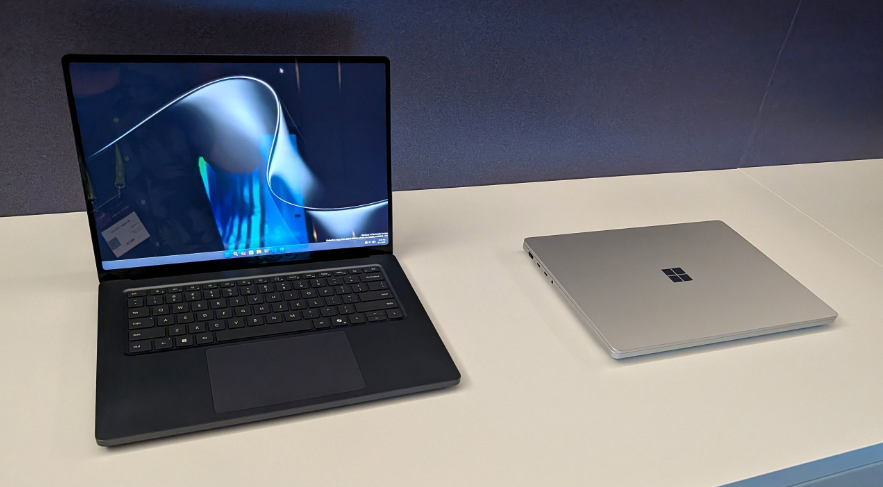
The Windows PC market is entering another major transition, and Microsoft is putting itself at the center of it. With the introduction of the Surface Laptop Ultra, Microsoft is pushing the idea that the next generation of laptops should not simply run AI-powered applications but perform more AI tasks directly on the device.
That shift could change what American consumers expect from a laptop. Instead of relying on cloud servers for every intelligent feature, users may increasingly expect their computers to summarize documents, edit photos, organize information, assist with creative projects, and handle other AI workloads locally.
The move comes at an important moment. Consumers are heading into the busy fall and holiday shopping season, while PC manufacturers are competing to make artificial intelligence a practical reason to upgrade. The Surface Laptop Ultra therefore represents more than another premium Windows computer. It is part of a larger battle over what the personal computer will look like in the AI era.
Microsoft Wants AI to Feel Like a Native PC Feature
For years, AI on consumer devices was largely associated with online services. A user typed a question into a website or app, the request traveled to a remote data center, and the answer came back through the internet.
AI PCs are changing that model.
Microsoft and its hardware partners are increasingly focused on computers with dedicated processing capabilities designed for AI workloads. These systems can handle certain tasks locally, potentially reducing dependence on the cloud while improving responsiveness and privacy for some applications.
The Surface Laptop Ultra arrives in this environment as Microsoft attempts to make the AI PC concept more compelling to everyday users.
The important question for consumers is no longer simply whether a laptop has AI capabilities. The bigger question is what those capabilities actually do during normal work and entertainment.
A laptop that can intelligently organize files, improve video calls, accelerate creative applications, or assist with writing could provide meaningful benefits. But consumers will also want to know how much these features affect performance, heat, storage, and power consumption.
The Nvidia Connection Makes Local AI More Interesting
One of the biggest developments surrounding the new generation of AI PCs is the increasing role of powerful graphics processors.
Nvidia has traditionally been associated with gaming GPUs, but its technology has become equally important to the broader AI industry. High-performance GPUs can process large numbers of calculations simultaneously, making them particularly useful for many AI workloads.
That makes the relationship between Microsoft and Nvidia especially interesting for Windows users.
A powerful Windows laptop can potentially serve as a portable AI workstation. Instead of sending every demanding task to a remote server, users may be able to run increasingly sophisticated AI applications on their own computers.
For creators, developers, engineers, and other professionals, that could be a major advantage.
Imagine a video editor generating effects without constantly uploading large files to the cloud. Imagine a developer experimenting with an AI model while traveling without depending entirely on an internet connection. Or imagine a photographer using intelligent image-processing tools directly on a laptop.
These scenarios explain why the AI PC market is becoming much more than a marketing exercise.
Performance Is Only Half the Story
There is an obvious temptation to judge the Surface Laptop Ultra by processor performance alone.
That would miss an important part of the equation.
A high-performance laptop needs to balance processing power with thermals, battery life, portability, and everyday usability. Consumers do not buy benchmark scores. They buy computers that need to work throughout an entire school day, business trip, flight, or creative session.
AI workloads can be demanding because they frequently use specialized processors. When users combine AI applications with video editing, gaming, high-resolution displays, or multiple applications, power consumption can become an important consideration.
That is why the Microsoft laptop battery remains an important part of the overall ownership experience. A computer can have impressive hardware, but if demanding workloads dramatically reduce unplugged runtime, users may need to change how they work.
Microsoft therefore faces a familiar challenge: deliver significantly more computing power without turning a premium laptop into a machine that constantly searches for an outlet.
Why Battery Life Matters More in the AI Era
Battery expectations are changing as laptops become more capable.
Traditional productivity tasks such as web browsing, word processing, and email can often be relatively efficient. AI workloads can be different. Depending on the software and hardware involved, intelligent processing may place additional demands on the CPU, GPU, or neural processing unit.
This does not necessarily mean that every AI feature will destroy battery life. In fact, one of the goals of dedicated AI hardware is to perform certain workloads more efficiently than using general-purpose processing alone.
The real test will be how these technologies behave in everyday use.
For an American professional moving between a home office, coffee shop, airport, and workplace, mobility is critical. A student may need a laptop to survive a full day of classes. A photographer may spend hours working away from a wall outlet. A sales professional may depend on the computer during an entire day of meetings.
In all of these situations, battery performance becomes part of the product’s value.
That also makes battery health increasingly relevant as laptops become long-term investments. Users who keep their computers for several years may eventually need to consider the condition of their Microsoft laptop battery, particularly if runtime has noticeably declined.
Surface Is Also Competing With Apple
Microsoft’s ambitions cannot be separated from Apple’s position in the premium laptop market.
Apple has spent years emphasizing the advantages of its custom silicon, particularly its combination of performance and efficiency. MacBook users have become accustomed to powerful laptops that can deliver strong performance without sacrificing portability.
That has created a difficult target for premium Windows PCs.
Microsoft needs to show that Windows can offer something equally compelling while maintaining the flexibility and software ecosystem that have historically defined the platform.
The Surface Laptop Ultra is therefore entering a competitive market where consumers are not simply comparing processors. They are comparing complete experiences.
How quickly does the computer wake up? How long does it last away from the charger? How well does it handle creative applications? How smoothly does it work with external monitors? How useful are its AI features? How quiet does it remain under load?
Those questions could matter more than a single benchmark number.
AI Could Change What Consumers Do With Their Laptops
The most interesting aspect of this trend is that AI could eventually change the role of the laptop itself.
For decades, the PC has primarily been a tool that waits for instructions. Users open an application, type commands, click buttons, and manually organize information.
AI introduces the possibility of a more proactive computer.
A future Windows laptop might understand what a user is working on and offer relevant assistance without requiring a complicated series of commands. It could potentially identify important information across documents, help prepare presentations, organize photos, or automate repetitive tasks.
The closer these functions move to the device, the more natural the experience could become.
That is one reason local AI processing is strategically important. A computer that can perform useful AI functions without constantly relying on a remote server could potentially respond faster and operate more independently.
It also gives manufacturers another way to differentiate their hardware in a market where traditional laptop specifications have become increasingly difficult to distinguish.
The Holiday Shopping Season Could Be a Major Test
Timing matters.
The Surface Laptop Ultra arrives as American consumers begin thinking seriously about holiday technology purchases. October is traditionally an important period for electronics retailers, with major promotional events encouraging shoppers to replace aging devices.
That gives Microsoft’s latest laptop a significant opportunity.
Consumers replacing an older Windows notebook may now see AI capabilities as one reason to upgrade. However, the price will remain crucial. Americans have become increasingly selective about expensive electronics, particularly when their existing laptop still performs basic tasks adequately.
Microsoft must therefore convince buyers that the new generation of hardware delivers meaningful benefits rather than simply adding another label to a familiar product category.
The strongest argument will be practical usefulness.
If AI can save users time every day, improve productivity, enhance creative work, or simplify complicated tasks, the upgrade becomes easier to justify.
What About Long-Term Ownership?
A premium laptop is rarely a one-year purchase.
Many American consumers expect their computers to remain useful for several years. That makes durability, software support, repairability, and battery longevity important considerations when evaluating new hardware.
AI may also change the way consumers think about future-proofing.
Applications are becoming increasingly intelligent, and future versions may require more local computing power. A laptop that looks extremely powerful today could eventually feel ordinary as AI software becomes more sophisticated.
This creates an interesting balance. Buyers want enough performance to remain comfortable for years, but they do not want to spend heavily on specifications they may never use.
Battery condition is another part of that long-term equation. If a laptop remains physically excellent but its battery capacity has declined significantly after years of use, replacing the Microsoft laptop battery may become a practical consideration for extending the device’s useful life rather than immediately purchasing a completely new computer.
A Bigger Battle Than One Laptop
The Surface Laptop Ultra is important because it represents a larger industry movement.
Microsoft is not alone in trying to redefine the PC around AI. Nvidia is pushing powerful local computing, while other chipmakers and laptop manufacturers are developing hardware designed specifically for intelligent workloads.
The result could be a new generation of computers where AI is no longer an optional application but a fundamental part of the operating system and hardware.
That would represent a meaningful change from the laptop market of the past decade.
The competition will likely focus on three major questions: how powerful the AI capabilities are, how efficiently they operate, and whether consumers actually find them useful.
The companies that answer those questions successfully could shape the next era of personal computing.
The Future of Windows PCs Is Becoming More Personal
The Surface Laptop Ultra arrives at a fascinating moment for American technology consumers.
The traditional laptop is not disappearing. People still need keyboards, large displays, reliable software, strong connectivity, and portable hardware. But the way those components work together is changing.
AI could make the PC more personalized, more proactive, and more capable of handling complicated tasks with less user effort. Local processing could make those experiences faster and potentially more private in certain situations.
At the same time, greater performance brings greater demands on the entire system. Cooling, efficiency, charging, and battery health will remain critical as laptops become increasingly powerful.
For Microsoft, the challenge is to make all of these improvements feel useful rather than merely futuristic.
For consumers, the opportunity is different: the next laptop upgrade may no longer be about simply getting a faster computer. It may be about getting a computer that can actually do more of the thinking alongside you.
That is the real promise behind the new generation of AI PCs—and it could make the Surface Laptop Ultra one of the most closely watched Windows laptops of the 2026 holiday season.
