
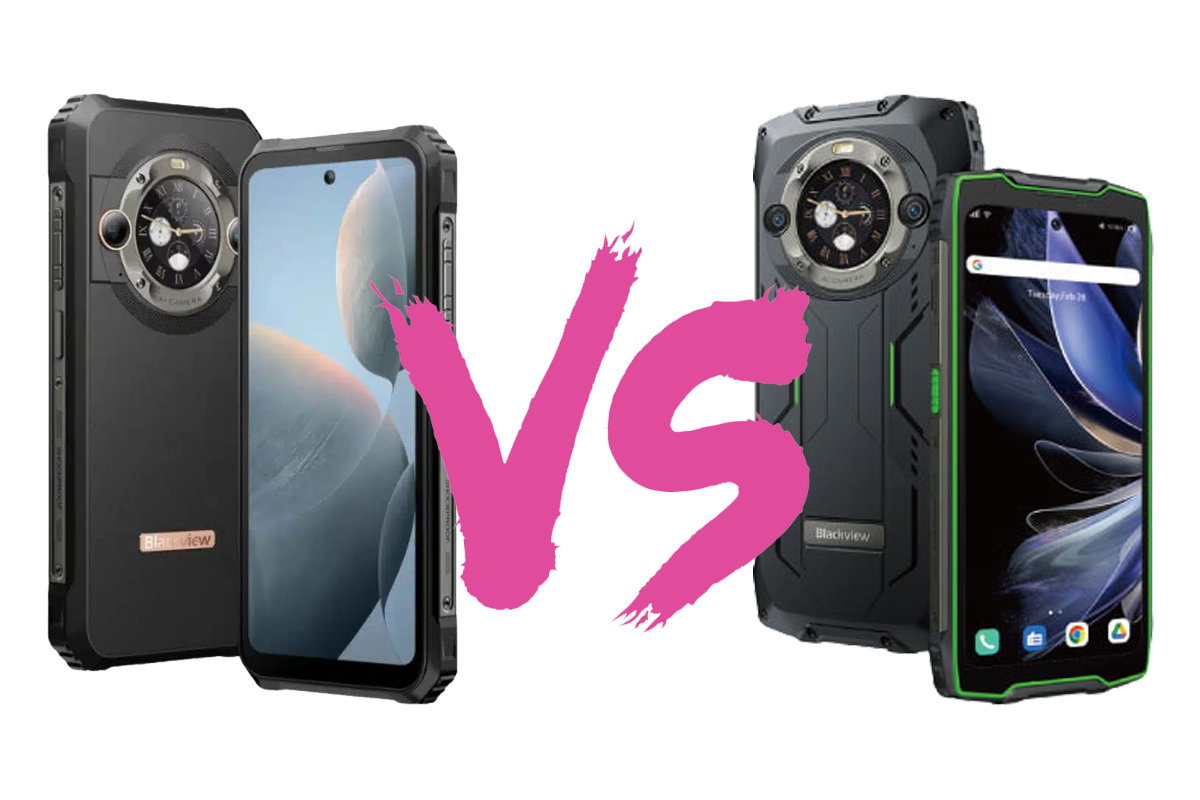
When shopping for a rugged smartphone, the choices can be overwhelming. Blackview offers two compelling options: the BL9000 Pro and the BV9300 Pro. The BL9000 Pro is priced nearly $200 higher than the standard BL9000, but what justifies that premium? And how does it stack up against the BV9300 Pro? This comprehensive guide breaks down every key difference—from display and battery to performance and special features—to help you decide which rugged phone is right for you.
Display: Size, Smoothness, and Extra Screens
The Blackview BV9300 Pro sports a dual-display design. Its primary screen is a 6.7-inch FHD+ IPS panel, but the unique 1.3-inch rear display sets it apart. This secondary screen lets you check notifications, time, or battery status without flipping the phone over, which conserves main battery life significantly.
The Blackview BL9000 Pro, meanwhile, offers a slightly larger 6.78-inch FHD+ screen. It not only matches the 500 nits brightness of the BV9300 Pro—ensuring readability under direct sunlight—but also brings a 120Hz refresh rate for smoother scrolling and animations. More importantly, it features a 240Hz touch sampling rate, delivering even faster response times for gaming or rapid tasks. Both phones include a Glove Mode, allowing easy touchscreen operation while wearing work gloves.
Size and Weight: Portability Matters
Rugged phones are never featherweights, but the BL9000 Pro is surprisingly slim for its category. It measures 179.5 x 82.6 x 17mm and weighs 412g. In contrast, the BV9300 Pro is noticeably bulkier and heavier at 525g. The extra heft comes from its enormous battery, so if you prioritize a lighter carry, the BL9000 Pro has a clear advantage.
Battery Performance: Endurance vs. Speed
This is where the two philosophies diverge most dramatically.
The BV9300 Pro is a battery beast. It packs a massive 15,080mAh cell, capable of lasting several days on a single charge under typical use. For long-distance travelers, remote workers, or anyone without regular access to power, this phone eliminates power anxiety entirely—you can go on multi-day treks without a power bank.
The BL9000 Pro takes a different route. To keep weight and thickness down, it houses an 8800mAh battery—still substantial, but smaller than the BV9300 Pro’s. However, it compensates with incredible 120W fast charging. This is about four times faster than the BV9300 Pro’s charging speed. In practice, you can fully charge the BL9000 Pro in a fraction of the time. If you have brief access to an outlet, you can top up rapidly and get back to work.
So, which is better? If you need days of off-grid endurance, choose the BV9300 Pro. If you prefer lighter weight and lightning-fast recharge, the BL9000 Pro wins.
Performance: 5G Speed vs. Reliable Efficiency
Under the hood, the BL9000 Pro is built for heavy lifting. It runs on the MediaTek Dimensity 8020 chipset—a high-performance processor that handles demanding apps and multitasking with ease. It supports 5G connectivity, giving you the fastest internet speeds available for downloading large files in seconds. Memory is also a standout: the BL9000 Pro offers up to 36GB of RAM (combining physical and virtual) and 512GB of built-in storage. This means you can run dozens of apps simultaneously without slowdown, and you’ll never worry about space for photos, videos, or work documents.
The BV9300 Pro uses the Helio G99 chipset, which is designed for reliable, battery-efficient performance. It handles everyday tasks and navigation tools smoothly, but it lacks 5G support—only 4G LTE is available. It offers up to 24GB of RAM and 256GB of internal storage, with the option to expand via a microSD card. For most rugged phone users, the Helio G99 is plenty capable, but the BL9000 Pro is undeniably faster and more future-proof.
Cameras: Thermal Imaging Sets the BL9000 Pro Apart
The BV9300 Pro features a solid camera setup: a 64MP main camera and an 8MP ultra-wide lens on the back, plus a 32MP front-facing selfie camera. This captures detailed shots and ensures sharp video calls.
The BL9000 Pro ups the ante. Its rear system includes a 50MP main camera and a 13MP ultra-wide & ultra-macro camera. But the real game-changer is the built-in FLIR Lepton 3.5 thermal imaging sensor. This allows you to “see” heat, not just light. For professionals like electricians, plumbers, or building inspectors, this is invaluable—you can detect overheating circuits, find hidden water leaks behind walls, or identify insulation gaps. No other rugged phone in this price range offers such a powerful thermal tool.
If thermal imaging is a must-have for your work, the BL9000 Pro is the obvious choice.
Durability: Both Are Built to Last
When it comes to ruggedness, both phones are equal. They share IP68 and IP69K ratings, meaning they are completely dustproof and can withstand submersion in water (IP68) as well as high-pressure, high-temperature water jets (IP69K). Additionally, both are MIL-STD-810H certified, so they survive drops, shocks, vibrations, and extreme temperatures. Whether you choose the BL9000 Pro or the BV9300 Pro, you’re getting a phone that can handle harsh job sites, outdoor adventures, and accidental abuse.
Conclusion: Which One Should You Choose?
There is no single “best” phone—it depends on your needs.
Pick the Blackview BV9300 Pro if:
- You are a long-distance traveler, remote worker, or frequently away from power sources for days.
- You prioritize maximum battery endurance over charging speed.
- You don’t need 5G or thermal imaging, and you want a reliable, rugged device at a lower price point.
Pick the Blackview BL9000 Pro if:
- You require thermal imaging for professional inspections (electrical, plumbing, HVAC, etc.).
- You want flagship-level performance with 5G, a 120Hz display, and massive RAM/storage.
- You prefer a lighter phone and appreciate 120W ultra-fast charging.
- Your work or lifestyle involves demanding apps, multitasking, or large file transfers.
The BL9000 Pro’s nearly $200 premium over the standard BL9000 is justified by its thermal camera, 5G chipset, faster display, and super-fast charging. But compared to the BV9300 Pro, the choice is clearer: thermal imaging and 5G vs. extreme battery life. Evaluate your daily needs, and you’ll know which rugged companion deserves a place in your pocket.
