
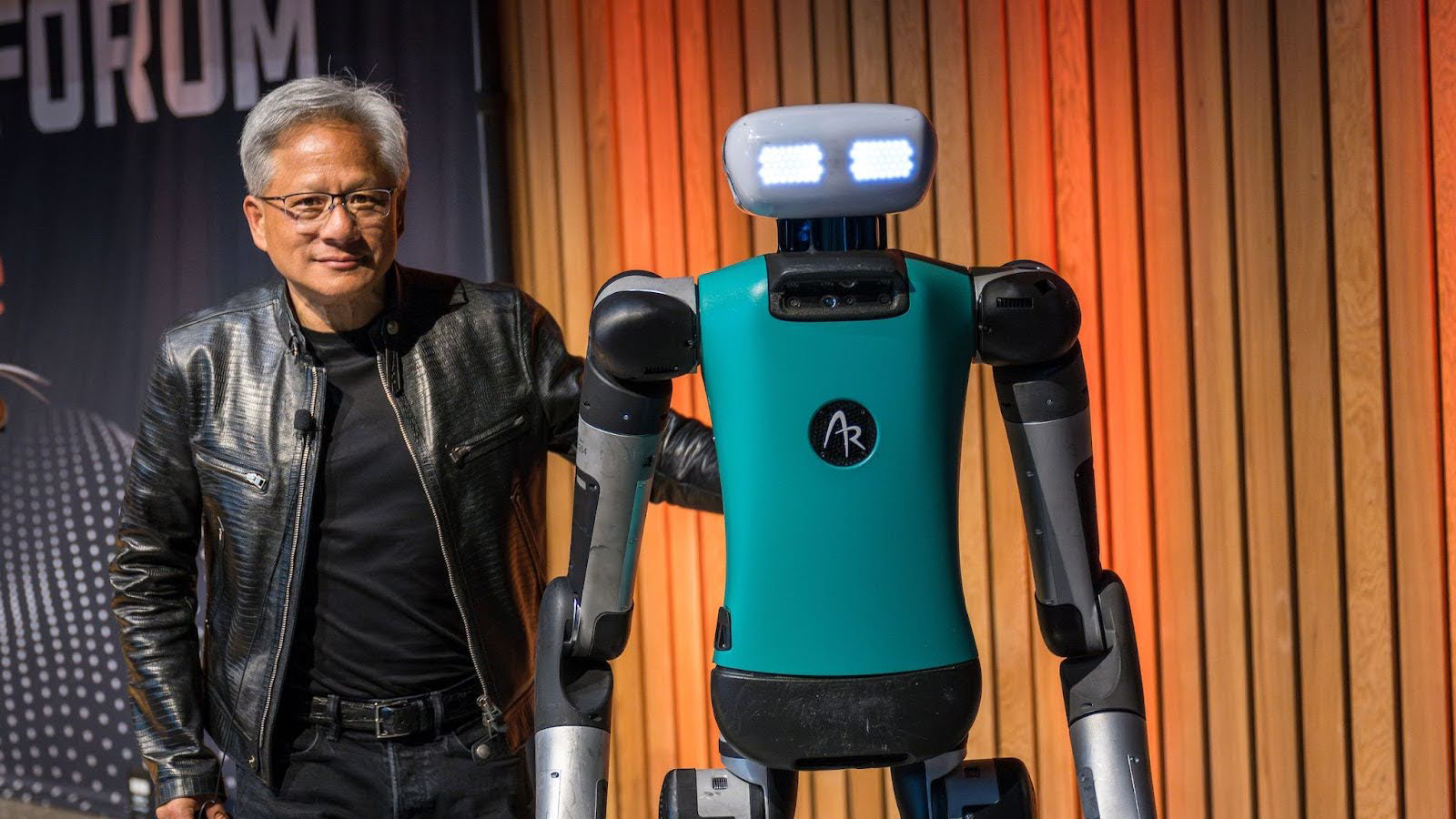
For years, Nvidia was best known for one thing: building the powerful chips that made modern artificial intelligence possible. Its graphics processors became the backbone of AI data centers, powering everything from large language models to generative AI applications. But in 2026, the company is increasingly associated with something much more physical: robots.
Nvidia is pushing aggressively into robotics, autonomous machines, and what the industry increasingly calls “physical AI.” Instead of simply teaching computers to understand text, images, or audio, physical AI aims to help machines understand the real world and act within it.
That shift could be enormous for the U.S. technology industry. Robots are no longer limited to repetitive factory arms. Humanoid robots, warehouse machines, autonomous vehicles, and intelligent service robots are becoming part of a broader race to combine advanced software with sophisticated hardware.
The question is no longer whether AI will enter the physical world. The question is who will provide the technology that allows millions of machines to understand and navigate that world.
From AI Chips to Robot Brains
Nvidia’s robotics strategy goes far beyond selling processors.
The company is building an entire technology stack designed to help developers create, train, simulate, and deploy intelligent robots. Its Isaac platform combines computing hardware, simulation tools, AI models, and software designed specifically for robotics. Nvidia has also positioned Isaac GR00T as an open reference platform for general-purpose humanoid robots.
This approach is important because robots have very different requirements from chatbots.
A chatbot can generate an answer in seconds without physically affecting the world around it. A robot operating in a warehouse, factory, or home has to perceive its surroundings, understand objects, predict movement, make decisions, and physically execute those decisions.
A small mistake can have real consequences.
That means robotics requires much more than a powerful AI model. It requires cameras, sensors, processors, motors, control systems, software, and reliable power management. Every component has to work together.
Nvidia appears to understand this challenge. Rather than competing only at the chip level, it is trying to become part of the complete infrastructure behind intelligent machines.
Why Physical AI Is Suddenly So Important
The rise of physical AI comes at a critical moment for the United States.
American manufacturers are dealing with labor shortages, rising costs, and increasing pressure to improve productivity. At the same time, companies are looking for ways to make factories more flexible without completely rebuilding their production systems.
Robotics could offer a solution.
A traditional industrial robot might perform one specific movement thousands of times a day. A new generation of AI-powered robots is being designed to handle a much broader range of tasks.
Imagine a robot that can identify a box, determine how to pick it up, move around an obstacle, place it on a shelf, and adapt when the environment changes.
That is a fundamentally different concept from traditional automation.
Recent industry developments show how quickly this idea is moving into commercial applications. Nvidia has been working with major robotics companies and technology partners to bring physical AI into real-world environments. The company has also highlighted applications ranging from industrial robots to humanoid machines and autonomous vehicles.
For American businesses, the attraction is obvious. If robots can become more flexible, companies may be able to automate tasks that previously required human workers.
Humanoid Robots Are Raising the Stakes
Humanoid robots are one of the most visible parts of this technology race.
Their human-like shape is not simply about making robots look familiar. A humanoid form can potentially allow a machine to operate in environments designed for people.
Factories, warehouses, retail stores, offices, and homes are filled with stairs, doors, shelves, tools, and workstations designed around the human body.
A robot that can walk, reach, grasp, and manipulate objects like a person could theoretically operate in these environments without requiring every location to be redesigned.
That possibility has attracted enormous attention from technology companies.
Nvidia’s Isaac GR00T platform is specifically aimed at helping developers build and train general-purpose humanoid robots. The system combines robot foundation models with simulation and development tools, allowing engineers to train machines before deploying them into the physical world.
This simulation-first approach could become one of the most important developments in robotics.
Instead of allowing a physical robot to make thousands of mistakes in an expensive factory, developers can train and test it in a virtual environment. The robot can encounter different objects, lighting conditions, layouts, and unexpected situations before it ever touches the real world.
That could dramatically accelerate development.
The Amazon Connection Shows Where Robotics Could Go Next
One of the most interesting developments is the growing relationship between AI infrastructure and warehouse automation.
Amazon is already one of the world’s largest users of warehouse robotics. In August 2026, Nvidia announced that Amazon Web Services would deploy additional Nvidia GPUs and that Amazon planned to adopt Nvidia’s physical AI technology for warehouse robots.
This is significant because warehouses are an ideal environment for physical AI.
They contain predictable processes but also countless variations. Packages have different shapes and sizes. Shelves can become crowded. Workers and machines share the same spaces. Orders change constantly.
A robot that can adapt to those conditions could be far more useful than a machine programmed to repeat one movement.
The combination of cloud computing, AI training, simulation, and robots creates a powerful technology loop. Robots generate real-world data. AI systems learn from that data. Better models make robots more capable. More capable robots create more opportunities for deployment.
Nvidia wants to be present throughout that loop.
Batteries Could Become an Unexpected Limitation
While AI models and processors receive most of the attention, power management may become one of the less glamorous but more important challenges in robotics.
A humanoid robot needs energy for computing, cameras, sensors, motors, communications, and cooling. Unlike a data center server connected to a massive electrical system, a mobile robot has to carry its energy source with it.
That makes every watt important.
An advanced electronic device battery inside a mobile robot must balance capacity, weight, safety, charging speed, and operating life. Adding more battery capacity can extend operating time, but heavier batteries also increase the energy required to move the robot.
This creates a difficult engineering trade-off.
A robot designed to work an entire shift cannot simply stop every hour for a lengthy recharge. Businesses will expect machines to operate efficiently and return to service quickly.
As a result, battery technology could become just as important to the future of robotics as processors and AI models.
The challenge becomes even more complicated when robots are expected to work continuously in warehouses or factories. Companies may need automated charging stations, battery-swapping systems, or fleets of robots that rotate between active work and charging.
The Hardware Problem Behind America’s Robotics Race
There is another challenge that is receiving increasing attention: supply chains.
The United States has enormous strengths in AI software, semiconductor design, cloud computing, and robotics research. But building physical robots requires a huge range of hardware components.
Motors, sensors, actuators, batteries, cameras, precision gears, controllers, and other components must all be manufactured at scale.
Recent reporting has highlighted concerns that U.S. robotics companies still rely heavily on overseas suppliers for many physical components, even as American companies develop increasingly sophisticated robotics software.
That creates an unusual situation.
The United States may have some of the world’s most advanced AI technology, but a robot is only as capable as the physical hardware supporting it.
This is why the robotics race is not simply an AI competition. It is also a manufacturing competition.
The country that can combine advanced AI with affordable, reliable, mass-produced hardware could gain a major advantage.
Safety Is Becoming a Bigger Issue
As robots move closer to humans, safety becomes another critical concern.
A factory robot operating behind a protective barrier has relatively limited interaction with people. A humanoid robot working next to employees is different.
It must recognize people, understand its surroundings, predict movement, and respond safely when something unexpected happens.
Nvidia has responded to this challenge with its Halos for Robotics initiative, which is designed as a comprehensive safety system for physical AI and robotics.
This reflects a broader change in the industry.
The goal is no longer simply to make robots faster or stronger. Developers need robots that are predictable, controllable, and safe enough to operate around humans.
That could determine how quickly humanoid robots move from demonstrations into everyday workplaces.
What Happens When Robots Leave the Factory?
The most exciting possibility may be what happens after industrial robotics becomes mature.
Robots could eventually move into restaurants, hospitals, hotels, retail stores, construction sites, and homes.
Imagine a household robot that can recognize objects, carry groceries, organize a room, or assist an elderly person. Imagine a retail robot that can restock shelves without needing detailed instructions for every product.
These applications remain challenging, but the underlying technology is moving in that direction.
The recent popularity of small experimental robots also shows that robotics is becoming more accessible to developers and hobbyists. In August 2026, Hugging Face introduced a $399 open-source robot designed to let users teach it new behaviors through reinforcement learning.
That kind of accessibility could be important.
The future of robotics may not be controlled entirely by a handful of giant corporations. Open platforms could allow universities, startups, developers, and independent researchers to experiment with new robot behaviors.
Why Nvidia Wants to Be at the Center
Nvidia’s biggest advantage may not be any single chip or robot.
It may be the ecosystem.
The company already has enormous influence over AI computing. Its GPUs are widely used for training and running advanced AI models. Now Nvidia is extending that ecosystem into robotics by providing simulation tools, foundation models, development platforms, and specialized computing hardware.
If successful, Nvidia could become something like the infrastructure layer for physical AI.
Robot manufacturers could build different machines while relying on a common technology foundation underneath them.
That strategy would allow Nvidia to benefit even if it does not manufacture the final robot itself.
It is a powerful business model because the robotics industry could eventually contain thousands of different machines. Factory robots, delivery robots, humanoids, agricultural machines, autonomous vehicles, and household robots could all require different physical designs while sharing similar AI infrastructure.
The U.S. Robotics Race Is Only Beginning
The global competition is becoming more intense.
China’s rapid progress in humanoid robotics has attracted worldwide attention. At the 2026 World Humanoid Robot Games in Beijing, more than 2,000 robots competed across dozens of events, highlighting the speed at which Chinese companies are developing physical robotics hardware.
For the United States, that creates pressure.
America has a powerful AI ecosystem, but maintaining leadership in physical AI requires more than developing better algorithms. It requires manufacturing capacity, energy infrastructure, advanced sensors, reliable components, skilled workers, and long-term investment.
Nvidia is betting that its AI advantage can become a robotics advantage.
Whether that bet succeeds will depend on how quickly robots become genuinely useful outside controlled demonstrations.
From Screens to the Physical World
The first wave of AI changed what computers could say, write, see, and generate.
The next wave could change what machines can physically do.
That is why Nvidia’s robotics strategy deserves attention. The company is attempting to connect the digital world of AI with the physical world of machines.
The transition will not happen overnight. Robots still face serious challenges involving cost, safety, reliability, battery life, dexterity, and real-world decision-making.
An advanced electronic device battery will not solve those problems, just as a powerful AI chip cannot make a robot automatically intelligent. Every part of the system must work together.
But that is precisely what makes the robotics race so fascinating.
If Nvidia and its partners succeed, the next major computing platform may not sit on a desk, in a smartphone, or inside a data center.
It may walk into the room.
And when that happens, Nvidia’s most important product may no longer be the chip inside the computer. It could be the technology that gives machines the ability to understand the world, learn from it, and act within it.
For American technology companies, manufacturers, and consumers, that future is getting closer—and the robotics race is just beginning.
