
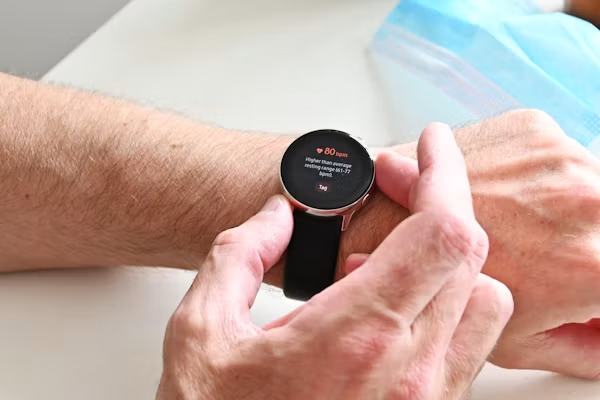
A New Role for the Smartwatch
For years, Americans have treated smartwatches as convenient accessories for checking notifications, counting steps, answering calls, and tracking workouts. In 2026, however, the role of the smartwatch is becoming much more closely connected to personal health.
Modern wearable devices can continuously collect information related to heart rate, activity, sleep, body temperature, blood oxygen, and other physiological signals. Some devices can also provide features related to heart rhythm notifications and other health measurements. The FDA maintains a list of authorized sensor-based digital health technology devices, including certain wearable products such as smartwatches, rings, patches, and bands.
This shift is changing the conversation around preventive healthcare in the United States. Instead of waiting for an annual physical or reacting to symptoms, consumers increasingly have access to health information throughout the day.
The question is no longer simply whether a smartwatch can count steps. The bigger question is whether wearable technology can help Americans recognize potential changes in their health earlier and have more informed conversations with healthcare professionals.
From Fitness Tracker to Health Companion
The evolution of the smartwatch has been remarkable. Earlier fitness trackers primarily focused on basic measurements such as steps, calories, and exercise duration. Today’s devices can combine multiple sensors with sophisticated software to create a much broader picture of daily health patterns.
For example, a user might notice that their resting heart rate has gradually changed over several weeks. Another person might see unusual changes in sleep duration or activity levels. Someone recovering from an illness may use wearable data to observe how their daily activity is returning to normal.
This does not mean a smartwatch has replaced a doctor. Instead, its potential value comes from continuous observation.
A medical appointment usually provides a snapshot of a person’s health at a particular moment. A wearable can potentially collect information during work, exercise, sleep, travel, and ordinary daily routines. Researchers and healthcare organizations are increasingly interested in this type of continuous data because digital health technologies can collect information remotely and outside traditional clinical settings.
That makes wearable technology particularly interesting for preventive healthcare.
Why Continuous Monitoring Matters
Many health changes do not happen at the exact moment someone visits a doctor’s office. A person may feel fine during an appointment but experience unusual symptoms at home or during exercise.
Continuous monitoring could help provide additional context.
Imagine someone who begins experiencing occasional fatigue. Instead of relying only on memory when describing the problem to a physician, that person may have weeks of activity and sleep information available through a wearable device. The data does not automatically explain the cause, but it can give the healthcare conversation more context.
The same concept can apply to cardiovascular health. Certain authorized smartwatch functions can provide notifications related to heart rhythm. The FDA has studied post-market performance of smartwatch cardiovascular notification functions and notes that these wearable features are not intended to provide diagnoses themselves.
This distinction is important. A smartwatch can potentially identify a pattern worth discussing with a healthcare professional, but it should not automatically be treated as a medical diagnosis.
The Battery Problem Behind Health Monitoring
There is another part of this transformation that consumers may not think about until their device runs out of power: battery life.
A smartwatch designed for health monitoring needs to remain available for long periods. Sensors may collect information throughout the day and night, while the display, wireless connectivity, GPS, processor, and background software also consume energy.
That makes the smart watch battery an important part of the overall health-monitoring experience.
A device with sophisticated sensors is less useful when users frequently remove it for charging. If someone wants to monitor sleep, overnight charging can create a gap in the data. If the watch is left at home because its battery is low, the device cannot collect information during the user’s daily activities.
Battery efficiency is therefore becoming closely connected to wearable health technology. Manufacturers have to balance sensor performance, processing power, screen brightness, connectivity, device size, and endurance.
For consumers, battery performance is no longer just a convenience feature. It can affect how consistently a wearable participates in their daily routine.
The Rise of Preventive Health at Home
Healthcare in America is also becoming more decentralized. Telehealth, remote monitoring, connected medical devices, and home-based testing are changing how patients interact with the healthcare system.
Wearables fit naturally into this trend because they can operate in environments where traditional medical equipment is not available.
A person does not have to sit in a clinic to record every heartbeat or every hour of sleep. Instead, wearable devices can collect information while the person goes about normal life.
The National Academy of Medicine has highlighted the growing use of AI-driven technologies outside hospitals and clinics, including technologies that can support remote monitoring and telehealth.
Smartwatches are one visible part of this larger movement.
The American Consumer Wants Simplicity
One reason smartwatches have potential in preventive healthcare is their familiarity.
Americans already use watches every day. They do not need to learn how to operate a specialized medical machine just to check a basic health metric. A familiar wrist-based interface can make health information easier to access.
This convenience could become increasingly important as wearable technology develops.
However, simplicity can also create misunderstandings. A colorful chart, notification, or health score may appear authoritative even when the underlying measurement has limitations.
Consumers therefore need to understand what a particular feature actually measures, how accurate it is, and whether it has been authorized for a specific medical purpose.
The FDA has emphasized that not every health-related feature on a wearable is equivalent to an authorized medical device. The agency has also warned consumers against smartwatches and smart rings that claim to independently measure blood glucose levels.
That warning illustrates an important principle: more sensors do not automatically mean better medical information.
AI Could Make Wearable Data More Useful
Another major development is the increasing use of artificial intelligence and advanced software to interpret large amounts of health information.
A smartwatch can collect enormous amounts of data. The challenge is deciding which information matters.
AI-assisted systems may eventually help identify patterns across heart rate, sleep, activity, temperature, and other measurements. Instead of showing users hundreds of separate numbers, future health platforms could potentially turn those measurements into more understandable trends.
The FDA already maintains a list of AI-enabled medical devices authorized for marketing in the United States, reflecting the growing role of AI in medical technology.
At the same time, AI does not eliminate the need for medical oversight. A software system can identify a statistical pattern without understanding every aspect of a person’s medical history.
That means the future of wearable healthcare is likely to involve cooperation between technology, patients, and healthcare professionals rather than complete replacement of one by another.
Privacy Becomes a Bigger Issue
As smartwatches become more capable health devices, privacy becomes increasingly important.
A smartwatch can generate information about sleep schedules, exercise habits, heart rate, location, and daily routines. When these data points are combined, they can create an unusually detailed picture of someone’s lifestyle.
Americans therefore have to think beyond the convenience of health tracking. They also need to consider where their data goes, which applications can access it, how long it is stored, and whether information is shared with other services.
The growth of connected medical devices also makes cybersecurity an important part of digital health. The FDA provides cybersecurity guidance for medical devices and considers security issues as part of the broader medical-device lifecycle.
A smarter health device needs to be designed with both useful functionality and responsible data protection in mind.
What Smartwatches Can and Cannot Tell You
The biggest mistake consumers can make is assuming that every number displayed on a smartwatch represents a medical fact.
Wearables can be useful for observing trends, encouraging healthy behaviors, and providing information that may be worth discussing with a healthcare professional. But measurement quality varies by device, feature, activity, and individual circumstances.
Research has also continued to examine the accuracy of Apple Watch health measurements, demonstrating why wearable readings need to be interpreted in context rather than automatically treated as clinical measurements.
For example, a smartwatch might notice an unusual heart-rate pattern. That information could be useful, but the appropriate response is not necessarily to diagnose oneself. Instead, the user may want to consider the circumstances, repeat the measurement when appropriate, and consult a qualified healthcare professional if there are concerns.
Preventive healthcare works best when technology provides additional information rather than replacing professional judgment.
Battery Life Could Shape the Next Generation
As health monitoring becomes more sophisticated, manufacturers will face a practical challenge: how can they collect more data without requiring users to charge their watches constantly?
The smart watch battery could become one of the most important components in this equation.
Longer battery life could support continuous sleep tracking, overnight monitoring, travel, exercise, and remote health applications. Faster charging can also reduce interruptions, but simply charging more often may not solve the problem for users who want continuous monitoring.
The challenge is especially significant for smaller wearable devices. A smartwatch has limited physical space, yet it must accommodate a battery, display, sensors, processor, wireless components, and other hardware.
Future improvements may therefore come not from simply installing a larger battery, but from improving power management, sensor efficiency, processor performance, display technology, and software optimization.
This is where hardware engineering becomes directly connected to healthcare.
The Potential for Remote Patient Monitoring
The most significant impact of wearable technology may eventually occur beyond the consumer fitness market.
Remote patient monitoring allows certain health information to be collected while patients remain at home. This can be particularly relevant for people who require ongoing observation or follow-up.
Wearable devices could potentially provide healthcare professionals with additional information between appointments, depending on the specific device, clinical program, and authorized functions.
Professional health-monitoring research also increasingly focuses on wearables and remote patient monitoring, with smartwatches representing one category of devices used for repeated measurements.
However, successful remote monitoring requires more than hardware. Healthcare organizations need systems for interpreting incoming information, managing alerts, protecting patient data, and determining when action is necessary.
Without that infrastructure, collecting more data can create confusion rather than better care.
What This Means for Everyday Americans
For ordinary consumers, the growing role of smartwatches in healthcare does not mean everyone needs to turn their wrist into a medical laboratory.
The more realistic change is that personal health information may become easier to observe.
Someone training for a marathon may use wearable data to understand recovery. A person trying to improve sleep may track bedtime consistency. Another user may become more aware of activity levels during a workday.
These simple applications can encourage people to pay closer attention to their health without turning every measurement into a diagnosis.
The key is using wearable information appropriately.
Consumers should also check whether a health feature is intended for general wellness or has specific regulatory authorization. The FDA’s 2026 General Wellness guidance provides additional clarity around low-risk products intended to promote healthy lifestyles.
The Next Era of Preventive Healthcare
Smartwatches are unlikely to become a replacement for doctors, hospitals, or traditional medical tests. Their more realistic role is as a bridge between everyday life and the healthcare system.
They can collect information while people are living their normal lives. They can make certain health trends easier to see. They can encourage users to become more engaged with their own health.
At the same time, the industry must address accuracy, privacy, cybersecurity, regulation, and battery life.
The smart watch battery may sound like a small hardware detail compared with AI, medical algorithms, and advanced sensors. Yet it is fundamental to the entire experience. A health-monitoring device needs to be available when users need it, and that requires dependable power.
As American healthcare continues moving toward connected, preventive, and home-based models, the humble smartwatch may become an increasingly important piece of the technology ecosystem. The real transformation will not come from a single sensor or app. It will come from combining reliable hardware, useful software, responsible regulation, and continuous access to meaningful health information.
For millions of Americans, that could make preventive healthcare feel less like something that happens only during a doctor’s appointment and more like an everyday part of modern life.
