
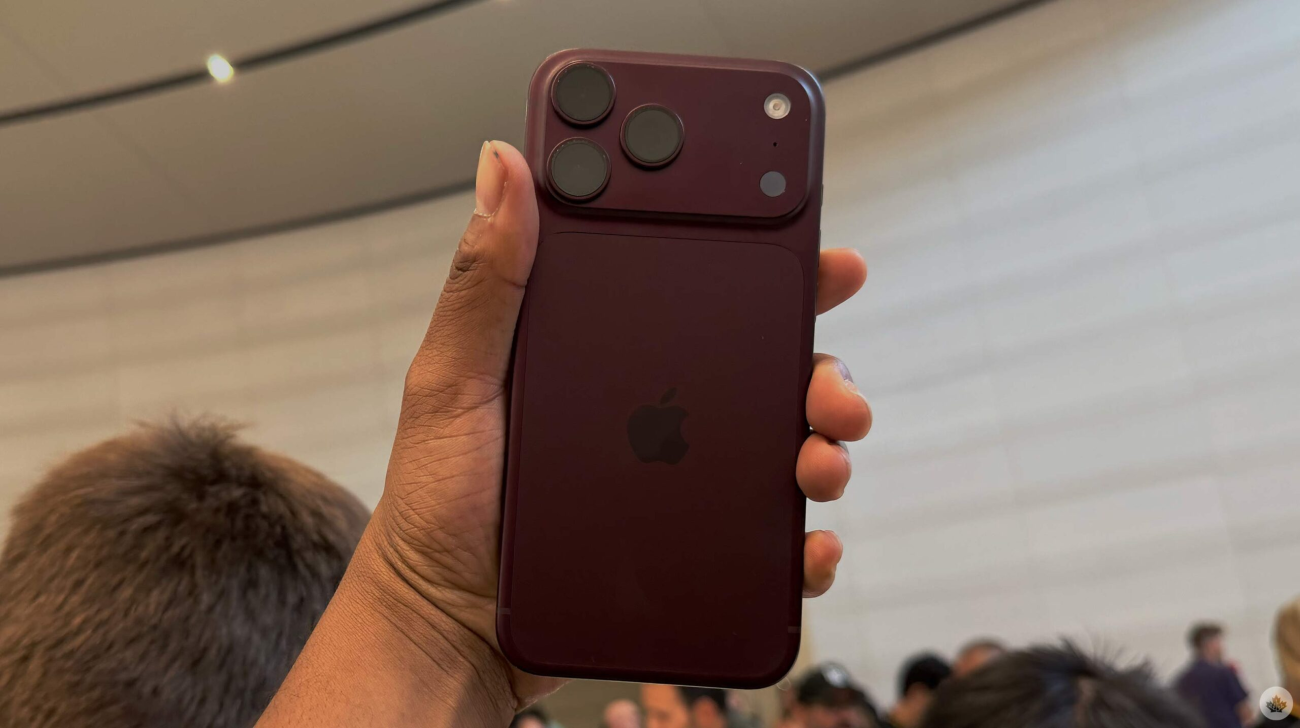
A New Chapter for iPhone Photography
For years, smartphone cameras have followed a familiar formula. Manufacturers added more megapixels, improved computational photography, increased zoom capabilities, and relied on artificial intelligence to make photos look better automatically. Those improvements have made modern phones remarkably capable, but Apple’s latest iPhone 18 Pro takes a somewhat different approach.
The biggest camera story surrounding the iPhone 18 Pro and iPhone 18 Pro Max is not simply another increase in resolution. Instead, Apple has introduced a variable-aperture system to the 48MP Fusion Main camera, giving the camera a new level of control over light and depth of field.
The new system can automatically adjust between four aperture settings, from f/1.48 to f/4.0. Users can also take greater manual control through the redesigned Pro controls in the Camera app. Apple says the wider aperture can improve low-light performance, while narrower settings can provide greater depth across a scene.
That makes the iPhone 18 Pro particularly interesting in the United States, where smartphones have increasingly become the primary camera for everything from family events and travel to social media content and professional video production.
Why Variable Aperture Matters
Aperture is one of the fundamental elements of traditional photography. It controls how much light enters a camera lens and influences how much of a scene appears in focus.
Most smartphone cameras historically depended heavily on fixed apertures combined with software processing. That approach works remarkably well, especially in challenging lighting conditions, but it gives photographers less direct optical control.
The iPhone 18 Pro changes that equation.
Its main camera can automatically select an aperture depending on the scene, while users who want more control can manually choose between different aperture settings. Apple provides f/1.48, f/1.8, f/2.8, and f/4.0 options. The widest setting is designed to collect more light, while narrower apertures can increase depth of field.
For an everyday American smartphone owner, that could mean less time worrying about camera settings. For photographers and creators, however, the change is potentially more significant.
A portrait shot in a dim restaurant, for example, can benefit from the wider aperture. A landscape photographed in bright daylight may benefit from a narrower setting that keeps more elements sharply defined.
This is the type of flexibility that has traditionally been associated with dedicated cameras rather than smartphones.
From Automatic Photography to Creative Control
Apple has spent years making computational photography do the hard work for users. HDR processing, Night mode, Deep Fusion, Smart HDR, and machine-learning-based photography have transformed smartphone imaging.
The iPhone 18 Pro does not abandon that philosophy. Instead, it adds more opportunities for users to take control.
The new Pro controls allow photographers to adjust aperture, shutter speed, white balance, and view a histogram directly within the Camera app. Smart Focus Tracking also uses on-device intelligence to help keep a moving subject in focus.
That combination could appeal to a growing group of American consumers who want professional-looking results without carrying a traditional camera everywhere.
A creator filming a short video for TikTok or Instagram can adjust exposure and shutter speed. A traveler can experiment with depth of field. A parent photographing children at a sports event can use faster shutter speeds to freeze movement.
The phone is still designed to work automatically, but it increasingly behaves like a camera when the user wants it to.
The Camera Is Only Part of the Upgrade
Photography may be the headline feature, but the iPhone 18 Pro is also built around Apple’s A20 Pro chip and a redesigned thermal system.
Apple says the new vapor chamber has three times the surface area of the previous design and can help the phone maintain performance during demanding workloads. The company also says the new system can deliver up to 40 percent better sustained performance than the iPhone 17 Pro under certain conditions.
That matters because smartphone photography is becoming increasingly computational.
Modern phones do much more than capture an image. They analyze subjects, combine multiple exposures, process colors, stabilize video, recognize faces, track movement, and apply machine-learning models.
As those workloads become more sophisticated, sustained performance and thermal management become increasingly important.
For consumers who shoot long videos, edit content directly on their phones, play demanding games, or use AI features regularly, maintaining performance over longer periods can be just as important as peak processor speed.
Battery Life Becomes More Important for Creators
More powerful cameras and processors naturally increase the importance of power efficiency.
The iPhone 18 Pro models introduce significant battery-life improvements, with Apple highlighting the iPhone 18 Pro Max as having the largest battery-life increase ever seen on an iPhone. Apple also lists up to 36 hours of video playback for the iPhone 18 Pro and up to 50 percent charging in around 15 minutes with a compatible 60W-capable adapter or higher.
For people who spend an entire day taking photos and recording video, battery endurance can influence how useful a phone actually feels.
A camera may be excellent on paper, but it is not particularly useful when the phone is nearly out of power halfway through a trip, concert, sporting event, or outdoor shoot.
That is why discussions around iPhone battery performance remain closely connected to the camera experience. A more capable imaging system encourages users to capture more content, and that can place additional demands on the device throughout the day.
For American travelers and creators, improved endurance can therefore be viewed as part of the broader photography upgrade rather than an isolated specification.
A Smartphone Camera for Social Media Creators
The American creator economy has changed what consumers expect from smartphone cameras.
A decade ago, people generally accepted a major difference between professional cameras and phones. Today, that gap has narrowed dramatically. YouTube creators, TikTok personalities, small businesses, real estate agents, restaurant owners, and independent filmmakers can all use smartphones as serious production tools.
The iPhone 18 Pro is clearly designed with that audience in mind.
The combination of 48MP cameras, variable aperture, Pro controls, advanced video features, and on-device processing gives creators more flexibility without requiring them to carry a traditional camera kit everywhere.
Apple also supports advanced video formats and professional-oriented controls, further positioning the device as something more than a conventional point-and-shoot smartphone.
For a small business owner shooting promotional content, for example, the ability to adjust exposure and depth of field directly on the phone could make the production process faster.
For independent creators, meanwhile, eliminating the need to switch between a smartphone and dedicated camera can make spontaneous content easier to produce.
Low-Light Photography Gets More Attention
Low-light photography remains one of the biggest challenges for small smartphone camera systems.
A larger traditional camera sensor can collect substantial amounts of light, but smartphone manufacturers face strict physical limitations. The camera has to fit into a remarkably thin device while also sharing space with processors, antennas, speakers, cooling hardware, and a battery.
Variable aperture provides another optical tool for addressing that challenge.
Apple says the iPhone 18 Pro’s f/1.48 aperture offers around 50 percent better low-light performance compared with the narrower aperture settings.
That could be particularly useful in common American shooting environments: restaurants, concerts, city streets at night, indoor parties, sports arenas, and evening travel scenes.
Instead of relying entirely on software to brighten a dark image, the camera can physically allow more light to reach the sensor.
The result is not simply a specification upgrade. It changes the way the camera can respond to different environments.
More Control Does Not Mean More Complexity
One potential concern with professional camera controls is that ordinary users may find them intimidating.
Apple’s approach attempts to avoid that problem by keeping automatic photography at the center of the experience.
Someone who simply opens the Camera app and presses the shutter button does not need to understand aperture, shutter speed, or histograms. The camera can make many of those decisions automatically.
At the same time, advanced users can dig deeper into the settings when they want to.
This two-level approach is important for a mass-market smartphone. A feature that is useful only to professional photographers would have limited appeal. But a feature that works automatically for casual users and provides additional control for experienced creators can serve both audiences.
That balance has become increasingly important as smartphones evolve from communication devices into all-purpose creative computers.
The iPhone 18 Pro and the Future of Mobile Photography
The arrival of variable aperture could influence how consumers think about smartphone cameras over the next several years.
The smartphone camera race is no longer simply about megapixel counts. Manufacturers are competing on sensor size, computational photography, optical zoom, stabilization, video capabilities, AI processing, and now optical control.
Apple’s move is particularly notable because variable aperture has been a familiar feature in traditional interchangeable-lens cameras for decades.
Bringing a version of that concept into a mainstream smartphone could encourage users to think differently about mobile photography.
Instead of asking whether a phone has the highest camera resolution, consumers may increasingly ask how much control the camera gives them.
That could push the industry toward more sophisticated optical systems across premium smartphones.
What It Means for Everyday iPhone Owners
Not every iPhone owner needs professional camera controls.
For many Americans, the most important improvements may be simpler: better photos at night, longer battery life, faster performance, better video, and a camera that reliably captures important moments.
The iPhone 18 Pro attempts to address all of those areas simultaneously.
Its improved imaging system is paired with the A20 Pro chip, stronger thermal management, new AI capabilities, and longer battery life. Apple also emphasizes durability and a redesigned body as part of the overall package.
That broader approach is significant.
Smartphone buyers rarely evaluate one specification in isolation. A better camera is more useful when the processor can handle image processing quickly. A powerful processor is more useful when the thermal system can sustain it. And all of those features are more practical when the iPhone battery can support a full day of demanding use.
The real innovation is therefore not one component, but the way these technologies work together.
A New Kind of Smartphone Camera Competition
The iPhone 18 Pro arrives at a moment when the smartphone market is increasingly focused on AI, professional photography, and on-device computing.
Apple’s new camera system shows that there is still room for hardware innovation even after years of computational photography improvements.
Variable aperture does not replace AI. It complements it.
The camera can physically control incoming light while software handles focus, image processing, subject recognition, and computational photography. That combination gives the smartphone a broader toolkit than either optical hardware or software could provide alone.
For consumers, the biggest impact may simply be that advanced photography becomes easier to access.
A person who has never owned a dedicated camera can experiment with aperture. A content creator can shoot more sophisticated video. A traveler can capture better images without carrying additional equipment.
Meanwhile, users who simply want their phone to work can continue relying on automatic modes.
The Bigger Picture for Apple’s Pro Line
The iPhone 18 Pro is ultimately part of a larger shift in what premium smartphones are expected to do.
Phones are becoming cameras, gaming machines, editing studios, AI assistants, communication hubs, and increasingly powerful computers.
That makes efficiency just as important as raw performance. A device needs to handle demanding tasks without becoming excessively hot or running out of power too quickly.
The latest Pro models show Apple’s attempt to balance those competing demands through a combination of new silicon, thermal engineering, camera hardware, software, and battery improvements.
For users who record large amounts of video or take hundreds of photos during a long day, keeping an eye on iPhone battery health will remain just as important as understanding the camera specifications.
After all, the best camera is only useful when it is ready to shoot.
A More Flexible Future for Smartphone Photography
The most interesting aspect of the iPhone 18 Pro may not be any single specification.
It is the direction Apple is taking mobile photography.
Instead of making every improvement invisible behind automatic processing, Apple is giving users more ways to interact with the camera itself. Variable aperture, manual exposure controls, customizable settings, advanced focus tracking, and professional video capabilities point toward a smartphone that can adapt to both casual and serious photography.
The iPhone 18 Pro therefore represents more than another annual camera upgrade. It reflects the changing expectations of American smartphone users, many of whom now expect a phone to serve as their primary camera and creative workstation.
As smartphone hardware continues to evolve, the competition will increasingly be about giving users both simplicity and control.
The iPhone 18 Pro’s variable-aperture camera is an important step in that direction, bringing a traditionally camera-oriented feature into a device millions of people already understand how to use.
For everyday users, it means more flexibility. For creators, it means more control. And for the smartphone industry, it signals that the next phase of mobile photography may be less about simply taking better pictures and more about giving people greater creative freedom.
