
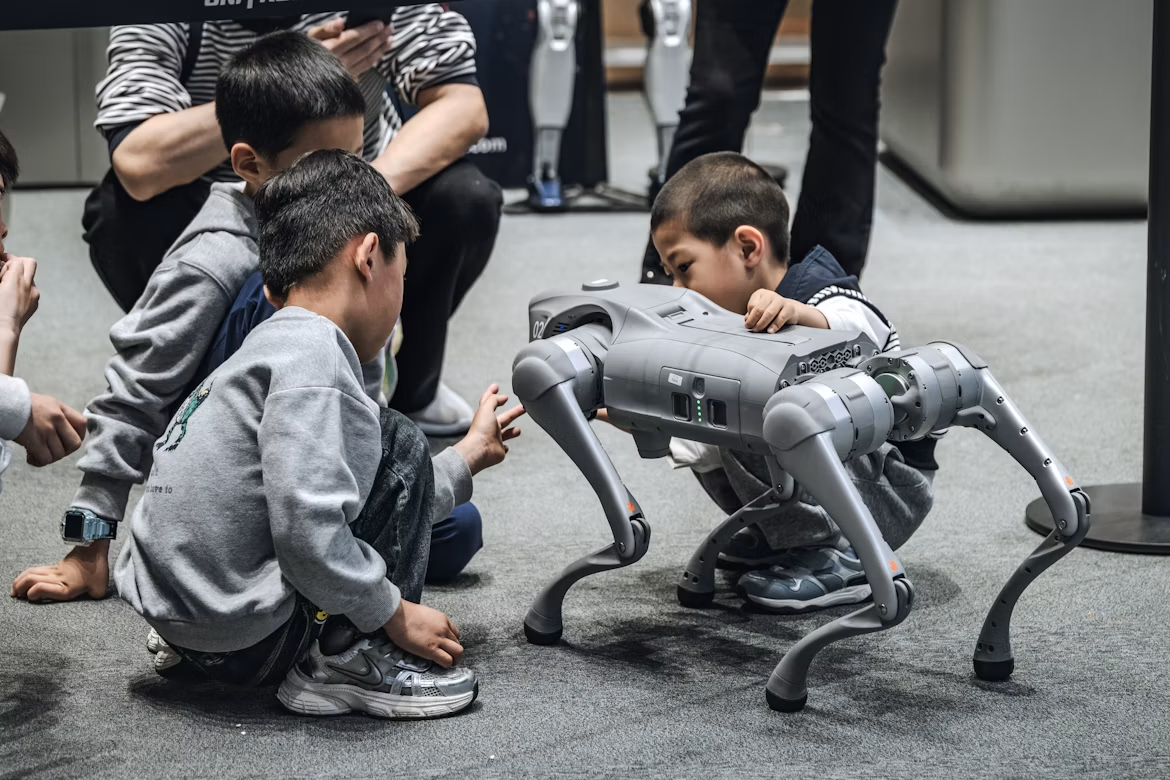
For years, humanoid robots and robot dogs have occupied a strange space in American technology culture. They were impressive enough to attract huge crowds at technology demonstrations, yet distant enough from everyday life to feel like machines from a science-fiction movie.
That distance is beginning to shrink.
In 2026, robotics companies are increasingly moving beyond demonstrations and laboratory experiments into factories, security environments, education, inspection, research, and other practical applications. Boston Dynamics, for example, has opened a new testing facility at a Hyundai Motor Group plant in Georgia to train its Atlas humanoid robots for automotive manufacturing tasks. Hyundai has said it plans to deploy large numbers of robots across its manufacturing operations over time.
At the same time, robot dogs are becoming increasingly recognizable as platforms for inspection, research, security, and mobility experiments. The machines are still expensive and far from being ordinary household appliances, but the technology surrounding them is changing quickly.
For American consumers, one question is becoming increasingly relevant: when robots become connected consumer devices rather than experimental machines, what happens to the batteries that power them?
From Science-Fiction Demonstrations to Real-World Machines
The biggest change in robotics is not necessarily that robots can walk, run, climb stairs, or manipulate objects. Researchers and engineers have demonstrated many of those capabilities before.
The more important shift is that companies are trying to make robots useful for repeated tasks in real environments.
Factories are particularly important because they offer controlled spaces where robots can perform predictable activities. Automotive manufacturing is one of the most visible examples. Boston Dynamics’ Atlas program is being developed with Hyundai Motor Group, with testing focused on manufacturing environments.
That creates a very different standard from a technology demonstration.
A robot that performs one impressive movement for a few minutes is interesting. A robot that can repeatedly complete a task during a long production shift is much more valuable to an industrial customer.
This is where robotics is entering a new phase. Reliability, battery endurance, charging systems, sensors, software updates, maintenance, and safety are becoming just as important as the robot’s ability to move.
Why Robot Dogs Are Getting More Attention
Humanoid robots receive much of the media attention because their appearance immediately communicates what they are designed to do: operate in spaces built for people.
Robot dogs take a different approach.
A four-legged platform can potentially move across uneven terrain, carry sensors, inspect industrial facilities, navigate difficult environments, and collect information without requiring a human operator to enter a potentially dangerous area.
This makes robot dogs useful beyond entertainment.
Companies and research organizations have explored quadruped robots for inspection and other specialized applications. Meanwhile, the technology has also attracted attention because of its connection to broader discussions about robotics supply chains and national security in the United States.
In July 2026, the Federal Communications Commission added certain foreign-produced advanced robotic devices to its Covered List, affecting new qualifying humanoid and quadruped robots that require FCC authorization. Existing authorized products were not automatically removed from the U.S. market.
That regulatory development means the American robotics market is being shaped not only by engineering and consumer demand, but also by questions surrounding connected hardware, cybersecurity, data, and supply chains.
The Battery Problem Becomes More Important
As robots become more mobile, battery performance becomes one of their fundamental limitations.
A humanoid robot may need to operate motors in its legs, arms, hands, torso, and joints while simultaneously running cameras, microphones, depth sensors, processors, wireless connections, and artificial intelligence software.
A robot dog faces a similar challenge.
Every additional sensor or processor consumes energy. More powerful motors can increase mobility but also increase power consumption. Running advanced AI locally can improve responsiveness, but it can also add another demand on the energy system.
This makes the consumer electronics battery concept increasingly relevant to robotics.
Although industrial robots often use specialized power systems rather than batteries designed for conventional consumer electronics, the underlying challenge is similar: deliver enough energy in a compact package without adding excessive weight.
For smaller robots, battery design can directly influence how long the machine can operate between charging sessions.
Weight Is a Bigger Issue Than It Looks
Battery capacity is not the only consideration.
Weight matters enormously for a walking robot.
Imagine a humanoid robot carrying a large battery pack. More battery capacity could increase operating time, but the additional mass also has to be lifted and moved by the robot’s motors.
That creates a balancing problem.
More energy can mean more weight. More weight can mean more energy consumption. More energy consumption can require an even larger battery.
Engineers therefore have to optimize the entire system rather than simply installing the biggest possible battery.
The same principle applies to robot dogs. A quadruped robot needs enough energy to power its motors while keeping its body relatively light and agile. Battery chemistry, cell configuration, thermal management, charging speed, and software-controlled power management can all influence practical performance.
This is one reason battery technology could quietly become one of the most important components in the next generation of mobile robots.
AI Is Changing What Robots Need From Their Batteries
Modern robots are not simply mechanical machines.
Many are increasingly designed around AI systems that allow them to interpret their surroundings and respond to changing situations.
A robot may use cameras to identify objects, sensors to understand its position, processors to interpret its environment, and AI models to decide what action to take next.
All of that requires computing power.
And computing power requires energy.
This creates an important connection between the AI hardware boom and robotics. As robots become more intelligent, their energy requirements can increase.
The industry therefore faces a difficult engineering question: how can robots become smarter without dramatically reducing operating time?
One solution is more efficient computing. Another is specialized AI hardware. Better sensors can also reduce unnecessary processing. Battery improvements represent another part of the equation.
For consumers eventually considering home robots, this could become especially important. People may care less about a robot’s theoretical processing power than about whether it can work for several hours before needing to recharge.
The Charging Experience Could Define Consumer Robotics
Smartphones taught consumers to think about battery percentage every day. Electric vehicles turned charging speed and charging infrastructure into major product considerations.
Robots could create another version of the same problem.
A household robot that requires several hours of charging after a short period of activity may be frustrating, regardless of how impressive its AI capabilities are.
Future consumer robots could therefore require sophisticated charging strategies.
A robot might automatically return to a charging station when its battery reaches a certain level. It could schedule charging when electricity demand is lower. It might also use software to predict when more energy will be needed based on upcoming tasks.
This turns charging into part of the robot’s intelligence.
Instead of simply asking whether a battery lasts eight hours, consumers may eventually ask whether the robot can intelligently manage its energy throughout an entire day.
What This Means for the Consumer Electronics Battery Market
Robotics could create new demand for batteries that are compact, rechargeable, durable, and capable of supporting frequent charge-and-discharge cycles.
The requirements will vary considerably.
A small educational robot may prioritize low weight and affordability. A home assistant robot may prioritize quiet operation and long runtime. A security robot could emphasize endurance and reliability. A humanoid robot working in a factory may require high power output and sophisticated thermal management.
That diversity could create opportunities for battery manufacturers and replacement-parts suppliers.
The consumer electronics battery market has traditionally been associated with smartphones, laptops, tablets, cameras, headphones, game consoles, and other portable devices. As robotics becomes more consumer-oriented, the boundary between consumer electronics and robotics hardware could become less obvious.
A robot with cameras, wireless connectivity, processors, displays, speakers, and rechargeable power is already beginning to resemble a highly mobile computer.
America Is Building a More Complicated Robotics Ecosystem
The United States is also developing its robotics ecosystem in the context of changing technology policy and supply-chain concerns.
The FCC’s 2026 action involving certain foreign-made advanced robotic devices demonstrates how robotics has moved into a broader national technology discussion.
The restrictions have also influenced companies that previously distributed foreign-made robots in the American market. Ars Technica reported in August that RoboStore, a U.S. distributor of Chinese humanoid and quadruped robots, was shifting toward domestic production at a Long Island facility.
That development illustrates an important trend: the future of American robotics may depend not only on software and mechanical engineering, but also on domestic manufacturing capacity.
Motors, sensors, batteries, controllers, processors, cameras, communication modules, and other components all contribute to the final product.
A robot is effectively an ecosystem on legs.
The Numbers Show How Early the Market Still Is
Despite all the excitement, today’s humanoid robot market remains relatively small.
According to figures from the International Federation of Robotics reported by Reuters, approximately 7,000 humanoid robots were sold globally in 2025 for industrial and professional service applications. The IFR’s data exclude consumer, military, and medical robots.
That distinction matters.
A viral video of a robot performing a complicated movement can create the impression that mass adoption is already happening. In reality, the industry is still working through basic commercialization questions.
Can robots operate reliably for long periods?
Can companies maintain them economically?
Can batteries provide sufficient runtime?
Can robots safely interact with humans?
Can manufacturers produce them at scale?
And perhaps most importantly, can these machines deliver enough practical value to justify their cost?
Those questions will shape the next stage of robotics.
Why 2026 Could Be a Turning Point
The significance of 2026 is not that every American home suddenly has a humanoid robot.
That has not happened.
Instead, the year represents a period when robotics is increasingly being tested against real-world requirements.
Factories are becoming testing grounds. Research institutions are experimenting with new capabilities. Security and inspection applications are receiving attention. Domestic robotics manufacturing is becoming a strategic issue. Meanwhile, companies are continuing to explore how AI can give machines more useful physical capabilities.
The movement from demonstration to deployment is the critical story.
A robot does not need to look perfectly human to be useful. It needs to perform a job reliably.
That could mean carrying objects, inspecting equipment, navigating a warehouse, assisting workers, collecting information, or performing repetitive tasks.
What Consumers Should Watch Next
For Americans following the robotics market, the most interesting developments may not always be the most spectacular robot videos.
Watch battery runtime.
Watch charging speed.
Watch whether robots can operate autonomously for extended periods.
Watch the cost of replacement parts.
Watch how manufacturers handle software updates and security.
And watch whether companies begin selling robots as complete consumer products rather than experimental platforms.
Battery technology deserves particular attention because it sits underneath nearly every mobile robotic capability.
The next generation of robots will need more than sophisticated AI. They will need dependable energy systems that can support motors, sensors, processors, cameras, and wireless communications without making the machines excessively heavy.
As robotics becomes more portable and more connected, the consumer electronics battery could become part of a much larger technology story.
The Next Robot May Feel Less Like a Machine
The most interesting change in robotics may ultimately be psychological.
People are accustomed to computers, phones, watches, headphones, cameras, and smart home devices. Robots combine many of those capabilities into a machine that can physically move through the environment.
That changes the relationship between people and technology.
A robot can see. It can hear. It can move. It can communicate. It can make decisions based on software. And, increasingly, it can learn how to perform physical tasks.
The challenge is turning those capabilities into something dependable enough for ordinary life.
The American robotics industry is still early in that process. But with humanoid robots entering industrial testing, robot dogs continuing to evolve, and governments and manufacturers paying greater attention to robotics supply chains, the technology is moving beyond the stage where it exists only for demonstrations.
For consumers, the future may not arrive as one dramatic robot launch.
It may arrive gradually — first in factories, then warehouses and public spaces, then specialized services, and eventually perhaps inside homes.
When that happens, the battery will be more than a hidden component.
It will help determine how useful, mobile, intelligent, and practical the robot can actually be.
And that makes the humble consumer electronics battery an increasingly important part of America’s emerging robotics story.
